Investigating Skill Transfer Mechanisms Between Simulated and Real-Stakes Poker Environments
Mia Simmons · Oct 8, 2026
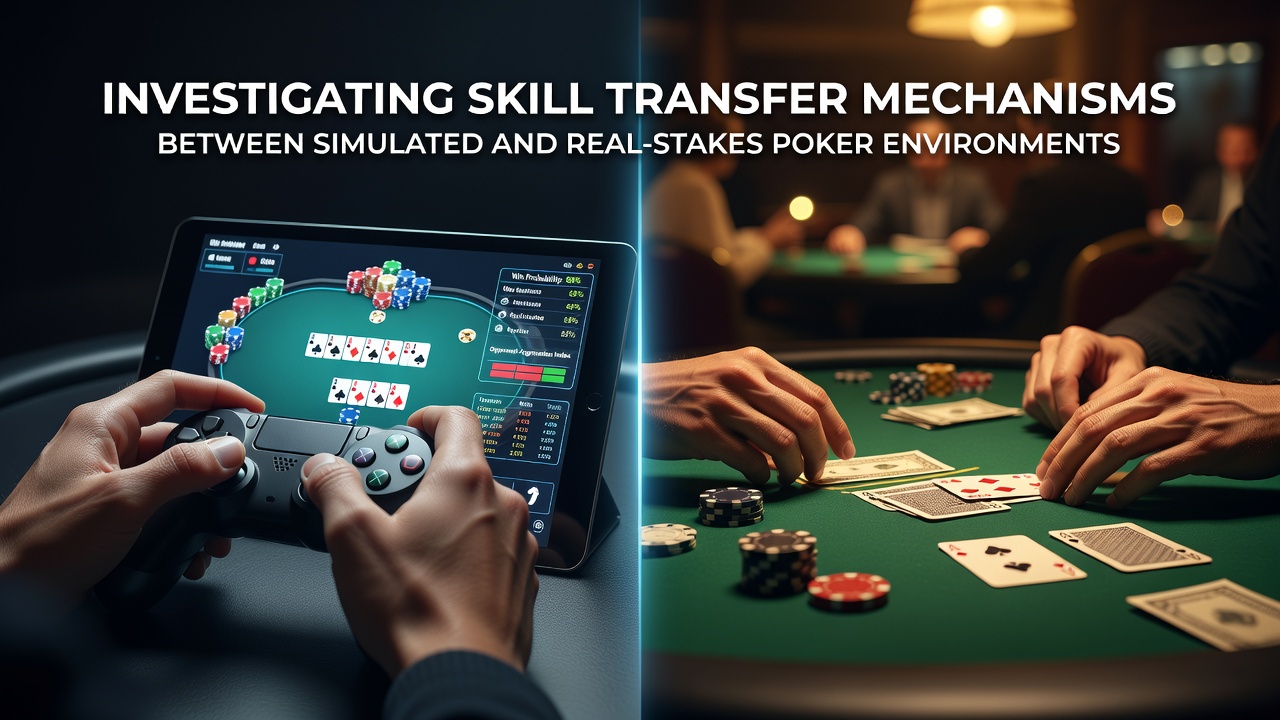
Investigating Skill Transfer Mechanisms Between Simulated and Real-Stakes Poker Environments
Skill transfer from simulated poker settings to real-stakes tables has drawn sustained attention from researchers and training programs since the expansion of online platforms in the mid-2010s, and data collected through October 2026 continues to map how practice environments shape decision-making under pressure. Simulated formats include play-money tables, bot-driven scenarios, and software trainers that replicate hand ranges without financial risk, whereas real-stakes environments add monetary consequences that alter emotional responses and risk assessment. Observers note that the core question centers on which cognitive and strategic elements carry over when players move between these contexts.
Core Components of Simulated Training
Simulated poker environments allow repeated exposure to specific situations such as multi-way pots, short-stack decisions, and river bluff spots without immediate capital loss, and platforms track metrics like fold frequency and aggression factor across thousands of hands. Researchers have documented that players who complete structured simulation modules often improve their pre-flop hand selection accuracy when measured against control groups, yet the same datasets reveal variability once real money enters the equation. Training software records precise timing and bet sizing patterns that coaches later review, while independent studies quantify how many hours of simulation correlate with measurable gains in hand-reading accuracy during live sessions.
Empirical Evidence on Transfer Rates
Multiple academic projects have tracked cohorts moving from simulation to real-money play, and results indicate that technical skills such as pot-odds calculation transfer more readily than emotional regulation under variance. One longitudinal analysis conducted across European online operators found that participants logging over 50,000 simulated hands showed a 12 percent reduction in common pre-flop errors when they later competed in low-stakes real-money tournaments, according to aggregated platform data released by the European Gaming and Betting Association. In contrast, Australian research groups monitoring state-licensed sites observed that impulse-control metrics, including tilt-induced over-aggression, required additional real-money exposure before stabilizing at levels achieved in simulation. These patterns suggest that simulation builds pattern recognition efficiently while real stakes introduce variables that demand separate adaptation periods.
Factors Influencing Successful Transfer
Bankroll size, session length, and opponent quality all modulate how well simulated skills translate, and data from North American operators shows that players who maintain strict bankroll rules during the transition phase retain more of their simulation-derived edge. Cognitive load studies demonstrate that real-money pressure increases working-memory demands during marginal decisions, which can temporarily degrade performance even when players have mastered the same spots in simulation. Observers have recorded that individuals who combine simulation with periodic low-stakes real-money trials exhibit faster stabilization of win rates compared with those who attempt direct jumps to higher buy-in events. Environmental cues such as interface familiarity and sound settings also play measurable roles, with researchers noting reduced decision latency when players retain the same software layout across both contexts.

Recent Developments Through October 2026
Updates released by the Nevada Gaming Control Board in October 2026 highlighted ongoing monitoring of skill-migration patterns among players transitioning from approved simulation tools to licensed real-money platforms, and the reports noted consistent correlations between structured practice volume and early-session performance stability. Industry groups have begun integrating biometric feedback into advanced simulators to replicate heart-rate spikes associated with real-money swings, aiming to close the remaining gap in emotional transfer. Meanwhile, university-led projects in Canada continue to examine whether AI-generated opponent models in simulation accelerate adaptation when players later face human ranges in cash games.
Practical Measurement Approaches
Coaches and analysts employ hand-history reviews, equity software comparisons, and session logging to quantify transfer success, and several commercial platforms now offer dashboards that contrast simulated versus real-money statistics side by side. These tools flag discrepancies in aggression frequency or river-call defense that often widen during the initial real-stakes period before converging again. Research teams emphasize the value of controlled A/B testing where one group receives simulation-only instruction while another adds graduated real-money exposure, producing clearer isolation of transfer variables. Such methodologies have become standard in training academies that prepare players for multi-variant circuits.
Conclusion
Evidence gathered to date shows that simulation environments reliably strengthen technical decision frameworks in poker, while real-stakes conditions add layers of emotional and financial feedback that require targeted bridging strategies. Continued data collection across regulatory jurisdictions and academic centers will refine understanding of which specific mechanisms transfer most efficiently and under what conditions, providing clearer guidance for players and training programs alike.