The Interconnection of Hand Range Construction Techniques Across Different Poker Variants in Competitive Online Settings
Mia Simmons · Oct 22, 2026

The Interconnection of Hand Range Construction Techniques Across Different Poker Variants in Competitive Online Settings
Hand range construction forms a core element of strategic decision-making in multiple poker formats, and players in competitive online environments often transfer principles from one variant to another while adjusting for structural differences. Data from major platforms shows that participants who master range building in no-limit hold'em frequently apply similar equity calculations when moving into pot-limit omaha or seven-card stud games, though the number of possible combinations expands significantly in those formats.
Core Principles Shared Across Variants
Researchers tracking online play have documented how starting hand selection in hold'em creates templates that carry over when players construct ranges in omaha, where four-card holdings replace two-card combinations yet retain emphasis on suited connectors and high pairs for post-flop play. Observers note that equity realization calculations remain consistent because the underlying mathematics of outs and pot odds stays constant, even as board textures change between variants. Competitive sites record thousands of hands daily, and those datasets reveal patterns where successful players narrow ranges in early position across all games while widening them on the button.
Software tools used in online training environments allow users to import hold'em range charts and automatically adjust them for omaha by expanding the matrix to account for double-suited combinations. Figures from platform analytics indicate that users who employ these cross-variant filters improve their decision speed during multi-table sessions that mix hold'em and omaha tournaments.
Adaptation in Split-Pot and Stud Games
Seven-card stud and razz introduce different range dynamics because exposed cards alter information available to opponents, yet the foundational concept of assigning ranges to each street persists. Players who have studied hold'em range construction often build stud ranges by eliminating hands that conflict with visible cards on the board, a technique that mirrors the process of removing dominated holdings in hold'em. Online data collected during mixed-game events shows that participants who rotate through hold'em, omaha, and stud maintain higher consistency when they apply the same frequency-based betting strategies rather than switching mental frameworks entirely.
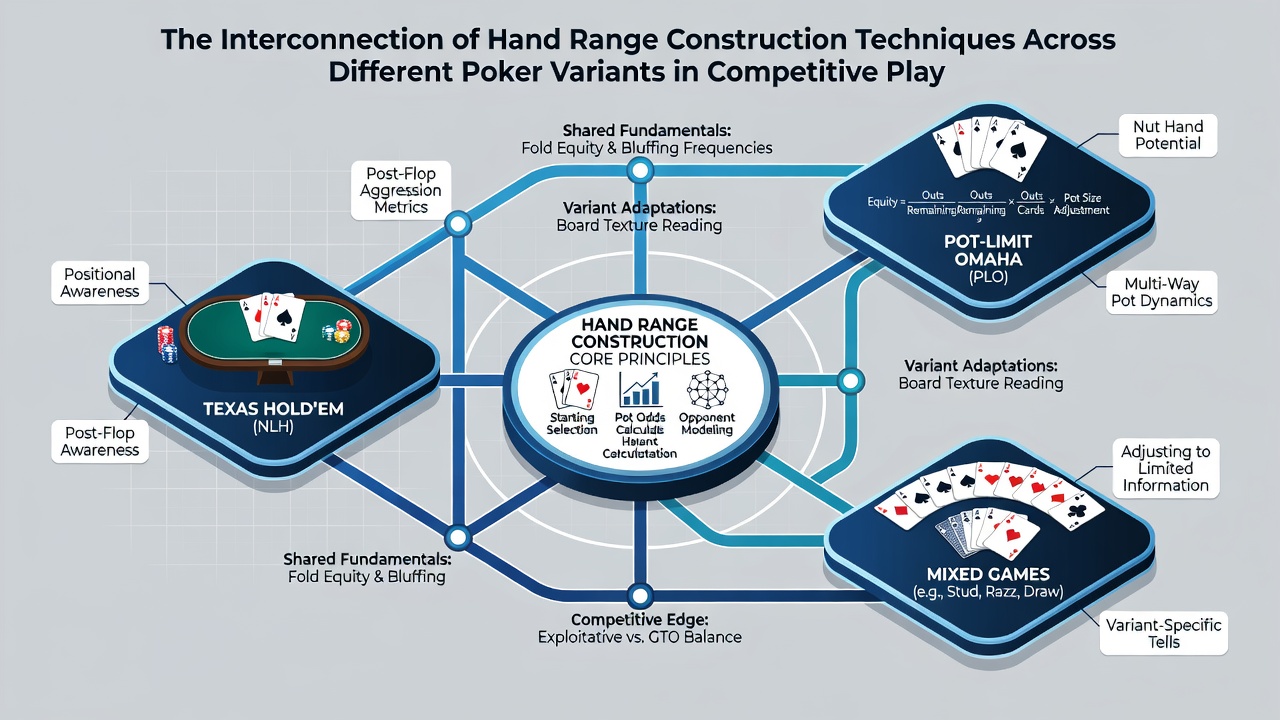
According to reports from the European Gaming and Betting Association, mixed-game formats on licensed platforms have grown steadily through 2026, with October schedules featuring dedicated mixed-game series that encourage players to refine these interconnected techniques. The data highlights how range construction methods transfer more efficiently when players use the same equity software across all variants instead of maintaining separate models.
Online Platforms and Data Integration
Competitive online settings provide extensive hand history exports that enable detailed range analysis across variants, and many players import these histories into solvers that handle multiple game types simultaneously. Studies from the University of Nevada Reno gaming research group indicate that solvers capable of processing both hold'em and omaha ranges help users identify overlapping strategic spots, such as continuation betting frequencies on specific board textures. Those who integrate this information reduce errors when switching between cash games and tournaments that feature multiple variants in a single session.
Platform operators track player migration patterns, and figures reveal that individuals who begin in hold'em cash games often expand into omaha and stud once they achieve proficiency with range construction in their original format. The process accelerates when training sites supply pre-built ranges that users can modify rather than build from scratch for each new game.
Strategic Adjustments in Real-Time Competition
Live online tournaments scheduled for October 2026 continue to feature mixed-game events where range construction speed becomes critical during rapid blind increases. Participants who have internalized connections between variants spend less time recalculating equities because they recognize familiar patterns across different betting structures. Observers tracking high-volume players note that those who maintain unified range databases perform better in late-night sessions that span multiple formats.
Industry reports from the Australian Interactive Gambling Council document how regulatory frameworks in licensed jurisdictions support the use of analytical tools that operate across variants, allowing players to maintain consistent range strategies while complying with platform rules. These tools track frequency adjustments automatically, freeing mental resources for real-time decision making.
Conclusion
The interconnection of hand range construction techniques across poker variants rests on shared mathematical foundations that persist regardless of card distribution rules or betting structures. Online competitive environments supply the hand data and software necessary for players to develop and refine these connected approaches systematically. As mixed-game formats maintain their presence on major platforms, the transfer of range construction skills continues to shape how participants prepare for and execute strategies across hold'em, omaha, and stud variants.